How Well Does Orforglipron Work? Phase 3 Trial Results Explained
Orforglipron Phase 3 trials show ~11% weight loss in ATTAIN-1 and strong A1C drops in ACHIEVE-1. Here's what the data says and how it stacks up vs Wegovy and Mounjaro.
How Well Does Orforglipron Work? Phase 3 Trial Results Explained
When Eli Lilly's investigational oral GLP-1 pill orforglipron moved into Phase 3 trials, the question on everyone's lips was simple: can a tablet really compete with the weight-loss injections that have dominated the last few years?
The answer, based on the trial programme published through 2025 and 2026, is largely yes — though with some important nuances. This guide walks through what the trials actually measured, the headline weight-loss and blood-sugar results, the side-effect profile, and how the numbers compare with Wegovy (semaglutide) and Mounjaro (tirzepatide).
New to orforglipron? Start with our explainer on what orforglipron is and how it works. For when it might actually be available in Britain, see Orforglipron UK availability.
The trial programme at a glance
Lilly ran two parallel Phase 3 families:
- ACHIEVE — adults with type 2 diabetes
- ATTAIN — adults with obesity or overweight, with or without diabetes
Between them, the programmes have enrolled thousands of participants across multiple countries, comparing several doses of orforglipron (typically 3 mg, 6 mg, 12 mg, and 36 mg) against placebo, with one head-to-head trial against oral semaglutide (Rybelsus).
Three trials matter most for understanding how well orforglipron actually works:
| Trial | Population | Duration | What it measured |
|---|---|---|---|
| ACHIEVE-1 | Adults with type 2 diabetes | 40 weeks | Blood sugar (A1C) and weight |
| ATTAIN-1 | Adults with obesity or overweight (no diabetes) | 72 weeks | Weight loss |
| ATTAIN-2 | Adults with obesity or overweight and type 2 diabetes | Long-term | Weight and A1C |
A fourth, ACHIEVE-3, pitted orforglipron directly against oral semaglutide in type 2 diabetes — the first time the two oral GLP-1 drugs faced each other.
ACHIEVE-1: blood sugar and weight in type 2 diabetes
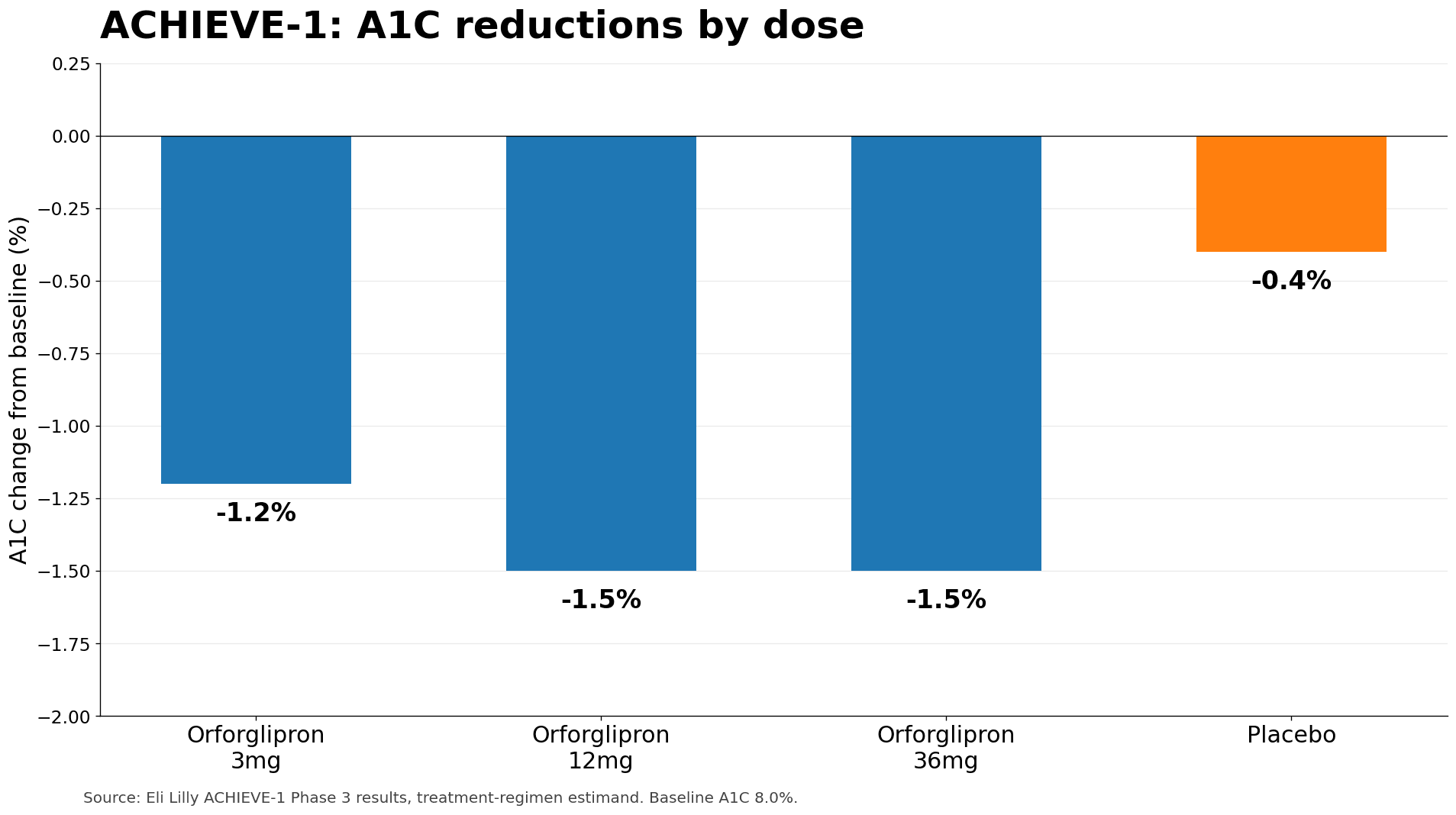
ACHIEVE-1 was the headline-grabbing trial that put orforglipron on the map. It enrolled 559 adults with type 2 diabetes inadequately controlled by diet and exercise alone, across the US, China, India, Japan, and Mexico. Participants took 3 mg, 12 mg, or 36 mg of orforglipron once daily, or placebo, for 40 weeks.
The headline results:
- A1C dropped by 1.3% to 1.6% across the orforglipron doses, from a baseline of 8.0%.
- More than 65% of patients on the highest (36 mg) dose got their A1C down to 6.5% or below — within the "non-diabetic" range.
- Weight loss at 36 mg averaged 7.9% — about 16 lbs (7.2 kg).
- At 12 mg, average weight loss was 5.2 kg; at 3 mg, 4.2 kg. Placebo: 1.5 kg.
For a Type 2 diabetes drug, that combination of A1C reduction and weight loss is squarely in the ballpark of injectable GLP-1 medications — a meaningful achievement for an oral tablet.
ATTAIN-1: weight loss in obesity (without diabetes)
ATTAIN-1 was the obesity trial — and the bigger commercial question for the UK weight-loss market. Adults with obesity or overweight (without type 2 diabetes) took 6 mg, 12 mg, or 36 mg of orforglipron, or placebo, once daily for 72 weeks. Results were published in the New England Journal of Medicine in 2025.
The headline numbers:
- 36 mg dose: average weight loss of 11.2% (vs 2.1% with placebo)
- 12 mg dose: 8.4%
- 6 mg dose: 7.5%
- 54.6% of patients on 36 mg lost at least 10% of their body weight
- 36% lost at least 15%
- 18.4% lost 20% or more
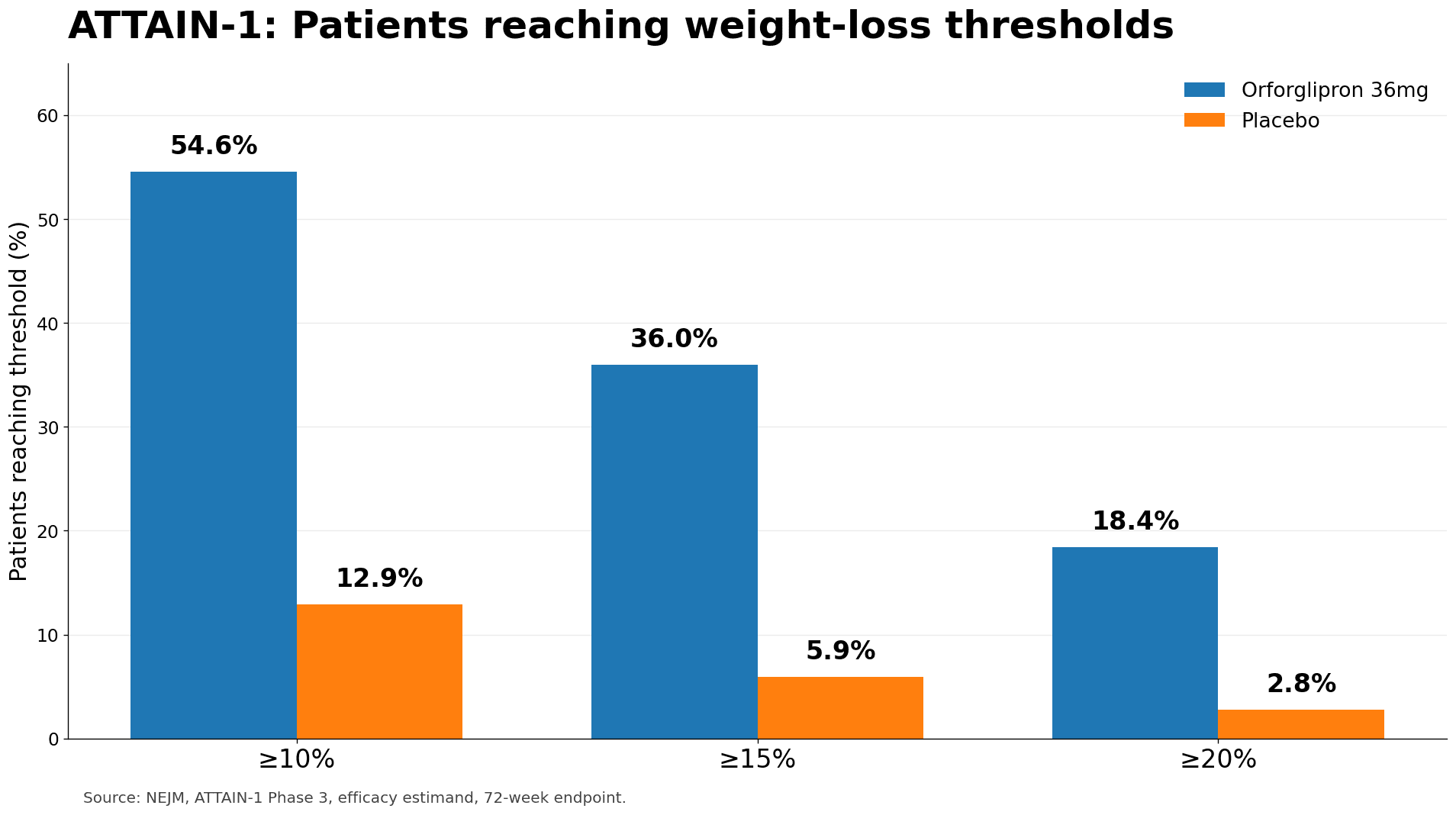
For context, "clinically meaningful" weight loss in obesity is typically defined as 5% or more — and over half the participants on the top dose blew well past that threshold.
Beyond the scale, ATTAIN-1 also showed improvements in waist circumference, systolic blood pressure, triglycerides, and non-HDL cholesterol — the cluster of cardiometabolic markers that drives most weight-related disease risk.
ATTAIN-2: when obesity and diabetes overlap
ATTAIN-2 looked at the group of people who often have the hardest time losing weight — adults who have both obesity and type 2 diabetes. It ran at 136 sites across ten countries.
On the highest dose:
- Weight loss averaged 10.5% (about 22.9 lbs / 10.4 kg) versus 2.2% with placebo
- A1C dropped by 1.8% on average — a slightly larger blood-sugar drop than in ACHIEVE-1, likely because the obesity-plus-diabetes population starts from a different baseline
The pattern is consistent: meaningful weight loss, strong glucose effect, all from a daily tablet.
ACHIEVE-3: head-to-head against oral semaglutide
The most interesting comparison so far comes from ACHIEVE-3, which pitted orforglipron against oral semaglutide (Rybelsus) in adults with type 2 diabetes. This was a direct, head-to-head trial — the gold standard for comparing two drugs.
The result, reported by Lilly and published in The Lancet, was that orforglipron delivered superior A1C reduction and superior weight loss versus oral semaglutide. That's a notable outcome because Rybelsus is the only other oral GLP-1 on the market — and it now appears to be the weaker of the two.
There are no published head-to-head trials between orforglipron and the injectable heavyweights — semaglutide (Wegovy) or tirzepatide (Mounjaro) — so all comparisons against those drugs are indirect.
Side effects and tolerability
The safety profile across the trials has been broadly what you'd expect from a GLP-1 medication — overwhelmingly gastrointestinal, mostly mild to moderate, mostly clustered around dose escalation.
Most commonly reported side effects across the programme:
- Diarrhoea
- Nausea
- Dyspepsia (indigestion)
- Constipation
- Vomiting
In ATTAIN-2, discontinuation due to adverse events ranged from 6.1% to 9.9% across the orforglipron doses, versus 4.1% on placebo. That's a real but manageable number — comparable to the discontinuation rates reported for injectable GLP-1s.
Importantly, Lilly described the safety and tolerability picture as "consistent with injectable GLP-1 medicines" — meaning no new or unexpected safety signals have shown up so far. Longer-term, real-world data will still be needed once the drug is in wide use.
How does orforglipron compare with Wegovy and Mounjaro?
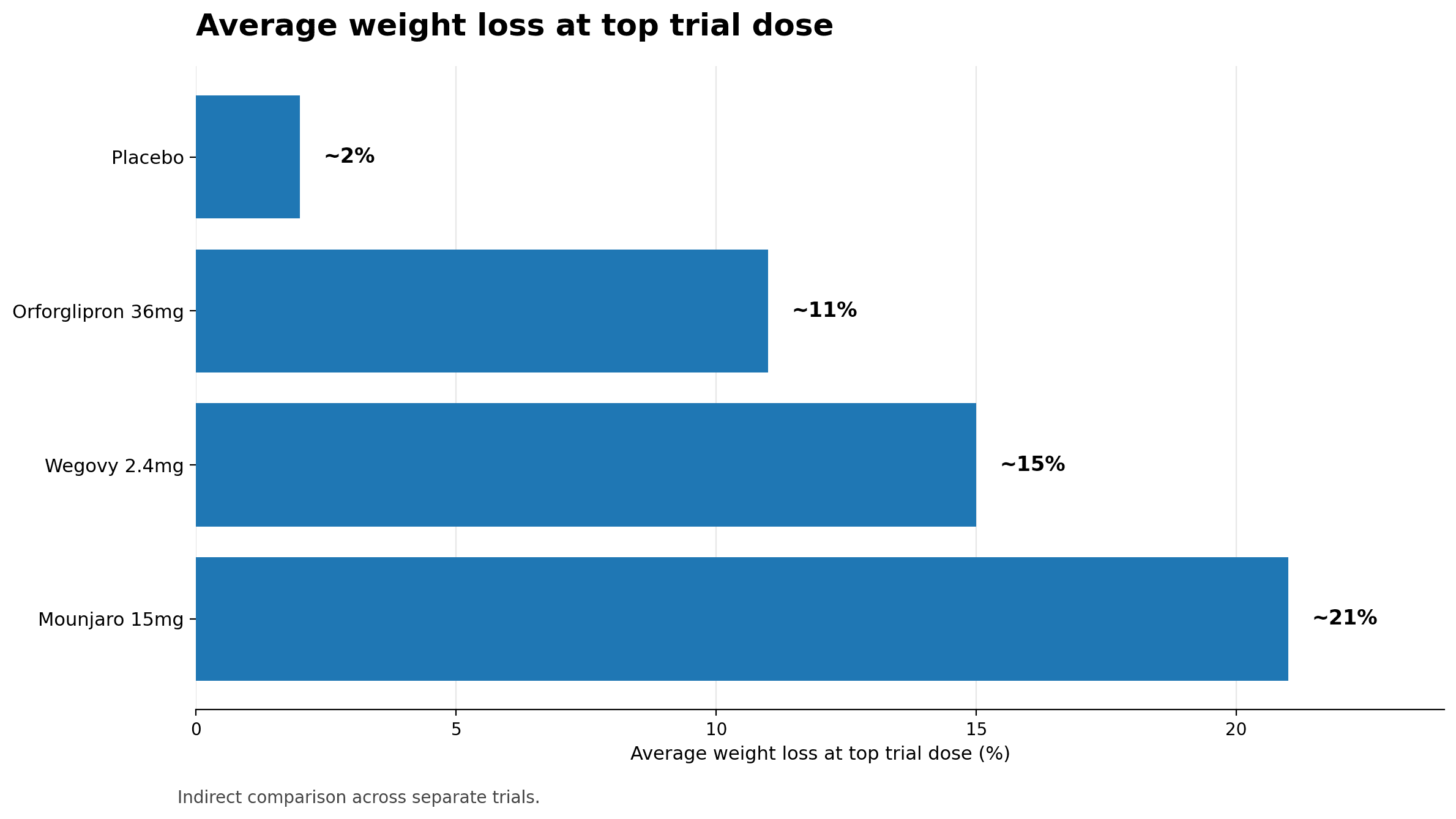
The honest answer is: roughly in the same league as semaglutide (Wegovy), but below tirzepatide (Mounjaro) — although these comparisons are based on separate trials, not direct head-to-head data.
| Drug (top trial dose) | Average weight loss | Duration | Trial |
|---|---|---|---|
| Orforglipron 36 mg (daily pill) | ~11.2% | 72 weeks | ATTAIN-1 |
| Semaglutide 2.4 mg (Wegovy, weekly injection) | ~14.9% | 68 weeks | STEP-1 |
| Tirzepatide 15 mg (Mounjaro, weekly injection) | ~20.9% | 72 weeks | SURMOUNT-1 |
A few caveats are essential:
- Different trial populations. STEP and SURMOUNT enrolled different baseline BMIs and demographics than ATTAIN. Indirect comparisons are useful for orientation, not for ranking.
- Tirzepatide is a dual agonist — it hits both GLP-1 and GIP receptors. Orforglipron only hits GLP-1. That structural difference helps explain Mounjaro's larger weight-loss numbers.
- Tablet vs injection trade-off. Some patients will happily accept slightly less weight loss in exchange for not having to inject themselves weekly. That's a real-world choice, not a trial outcome.
What the data doesn't tell us yet
The Phase 3 programme is large and well-conducted, but a few important things remain unknown until the drug has been in real-world use for longer:
- How well weight loss is maintained over many years. The ATTAIN-MAINTAIN study is starting to give us a picture, but multi-year real-world data is still limited.
- How orforglipron behaves in narrower populations — older adults, people with mild kidney impairment, people on multiple other medications.
- What the supply and pricing picture will look like. The trials answered the medical question, not the access question.
Our UK availability and timeframes guide covers the regulatory and supply side in detail.
FAQs
How much weight can you lose on orforglipron?
In the ATTAIN-1 obesity trial, the 36 mg dose produced an average weight loss of 11.2% over 72 weeks, with more than half of participants losing 10% or more, and around one in five losing 20% or more.
Is orforglipron as effective as Mounjaro or Wegovy?
In indirect comparisons, orforglipron sits roughly in line with Wegovy (semaglutide) and below Mounjaro (tirzepatide). There are no direct head-to-head trials with either Wegovy or Mounjaro.
Is orforglipron better than Rybelsus?
In the head-to-head ACHIEVE-3 trial in type 2 diabetes, orforglipron produced superior A1C reduction and weight loss compared with oral semaglutide (Rybelsus).
What are the most common side effects of orforglipron?
Diarrhoea, nausea, indigestion, constipation, and vomiting — almost all gastrointestinal, mostly mild to moderate, and mostly during the dose-escalation phase. About 6–10% of trial participants stopped the drug due to side effects.
Does orforglipron lower blood pressure or cholesterol?
ATTAIN-1 showed improvements in waist circumference, systolic blood pressure, triglycerides, and non-HDL cholesterol — the standard cardiometabolic markers — alongside the weight loss itself.
How long do you have to take orforglipron to see results?
In trials, weight loss continued to accumulate well past the six-month mark and was still progressing at 72 weeks. As with other GLP-1 medications, results are gradual, not overnight.
Do you have to keep taking orforglipron forever?
This is the same long-running debate that applies to Wegovy and Mounjaro. Trials of weight-loss medications consistently show that weight tends to return after the drug is stopped. Maintenance studies like ATTAIN-MAINTAIN are starting to clarify how to use these drugs long-term.
This article summarises Phase 3 trial results for orforglipron and does not constitute medical advice. Trial averages do not predict individual outcomes. Always speak to a qualified healthcare professional before starting, stopping, or considering any prescription medication.
Get weekly weight loss tips
Join our newsletter for provider updates, expert guidance, and exclusive offers — no spam.
Subscribe free